Writing effective prompts is the single most important skill for maximizing ChatGPT's potential. Whether you're a business professional, content creator, developer, or student, the difference between mediocre and exceptional AI responses comes down to prompt quality. In 2026, as ChatGPT continues to evolve with GPT-4 and beyond, understanding advanced prompting techniques has become essential. This comprehensive guide reveals the strategies, frameworks, and best practices that separate prompt engineering experts from casual users, complete with actionable examples you can apply immediately.
Understanding How ChatGPT Processes Your Prompts
Before diving into techniques, it's crucial to understand how ChatGPT interprets and responds to your input. Unlike traditional search engines that match keywords, ChatGPT uses advanced natural language processing to understand context, intent, and nuance.
The Attention Mechanism: What ChatGPT Focuses On
ChatGPT uses a transformer architecture with attention mechanisms that weigh different parts of your prompt. The model pays particular attention to:
- Explicit instructions: Direct commands like "write," "analyze," or "create" receive high priority
- Contextual clues: Information about audience, purpose, tone, and constraints shape the response style
- Examples provided: Sample outputs or formats guide ChatGPT's generation pattern
- Role assignments: Persona definitions (e.g., "you are an expert lawyer") influence knowledge activation
- Structural elements: Numbered lists, sections, and delimiters help organize the model's thinking
Token Limits and Context Windows
Understanding token limits helps you craft more effective prompts. As of 2026, GPT-4 supports up to 128,000 tokens (approximately 96,000 words), while GPT-3.5 handles 4,096 tokens. A token is roughly 4 characters in English, meaning:
- GPT-4 can process entire books, research papers, or extensive codebases in one conversation
- You can provide comprehensive context without worrying about length restrictions
- Earlier parts of long conversations may receive less attention than recent messages
- Complex prompts with detailed instructions are encouraged rather than discouraged
This massive context window means you should prioritize clarity and completeness over brevity. According to OpenAI's research (GPT-4 Technical Report), more detailed prompts consistently produce better results.
The 7 Essential Elements of Effective ChatGPT Prompts
Every high-performing ChatGPT prompt incorporates these foundational elements. Mastering them transforms your results from acceptable to exceptional. To learn more about these fundamentals, review our guide on essential elements of an effective AI prompt.
1. Clear Objective and Task Definition
Begin with a crystal-clear statement of what you want ChatGPT to accomplish. Vague requests produce vague results.
Weak Example:
Tell me about marketing.Strong Example:
Create a 3-month social media marketing strategy for a sustainable fashion brand targeting eco-conscious millennials. Include platform recommendations, content themes, posting frequency, and key performance indicators.2. Role or Persona Assignment
Assigning ChatGPT a specific role activates relevant knowledge patterns and shapes the response style. This technique, known as role-based prompting, dramatically improves output quality.
Example Roles:
- "You are a senior software architect with 15 years of experience in distributed systems"
- "Act as a financial advisor specializing in retirement planning for small business owners"
- "You are a creative writing professor providing constructive feedback on student work"
- "Assume the role of a cybersecurity expert conducting a threat analysis"

3. Comprehensive Context and Background
Context is king in prompt engineering. The more relevant information you provide, the better ChatGPT can tailor its response to your specific situation.
Context to Include:
- Target audience: Who will consume this content?
- Purpose: What should this accomplish?
- Constraints: Time limits, word counts, technical requirements
- Current situation: Relevant background information
- Tone and style: Formal, casual, technical, creative
- Success criteria: What defines a good result?
4. Specific Output Format Instructions
Tell ChatGPT exactly how you want the information presented. Structure matters enormously for usability.
Format Examples:
Format your response as:
1. Executive Summary (2-3 sentences)
2. Key Findings (bullet points)
3. Detailed Analysis (3 paragraphs)
4. Recommendations (numbered list)
5. Next Steps (action items with owners and deadlines)
5. Examples and Demonstrations (Few-Shot Learning)
Providing examples of what you want—known as few-shot learning—helps ChatGPT understand your exact requirements. This is especially powerful for unique formats or styles.
Example Template:
Generate product descriptions in this style:

Example 1:
Product: Wireless Earbuds
Description: "Immerse yourself in crystal-clear sound with our latest wireless earbuds. Engineered for the modern lifestyle, these compact companions deliver studio-quality audio for up to 24 hours. Seamless connectivity meets ergonomic design."

Example 2:
Product: Smart Watch
Description: "Your personal health coach, wrapped around your wrist. This smart watch transforms raw data into actionable insights, empowering you to optimize every aspect of your wellness journey. Style meets substance in every notification."

Now create a description for: [Your Product]
6. Constraints and Boundaries
Explicitly state what ChatGPT should NOT do or what limitations apply. This prevents unwanted tangents or inappropriate suggestions.
Constraint Examples:
- "Limit your response to 250 words maximum"
- "Do not include any code examples, only conceptual explanations"
- "Focus exclusively on free tools, no paid solutions"
- "Avoid technical jargon; explain as if to a complete beginner"
- "Do not suggest solutions that require more than $500 budget"
7. Reasoning and Verification Requests
Ask ChatGPT to explain its reasoning or verify its claims. This activates more thoughtful processing and reduces hallucinations.
Verification Phrases:
- "Think step-by-step before providing your answer"
- "Explain the reasoning behind each recommendation"
- "If you're uncertain about any information, explicitly state that"
- "Cite your sources or indicate if information should be verified"
- "Show your work for any calculations or logical deductions"
Advanced Prompting Techniques for 2026
Beyond the basics, these advanced techniques unlock ChatGPT's full potential for complex tasks and specialized use cases.
Chain-of-Thought (CoT) Prompting
Chain-of-thought prompting asks ChatGPT to break down complex problems into intermediate reasoning steps. This dramatically improves accuracy for logic, mathematics, and multi-step tasks.
Basic CoT Template:
Let's solve this step-by-step:

Problem: [Your complex question or task]

Please:
1. Break down the problem into smaller components
2. Address each component systematically
3. Show your reasoning at each step
4. Arrive at a final conclusion
5. Verify your answer makes logical sense
Real-World Example:
I need to decide whether to build a mobile app in-house or outsource development. Let's think through this step-by-step:

1. First, analyze the key factors to consider
2. Then, evaluate the pros and cons of each approach
3. Next, estimate costs and timelines for both options
4. Consider my specific constraints: $50K budget, 6-month timeline, team of 3 developers
5. Finally, provide a recommendation with clear reasoning
Tree of Thoughts (ToT) Prompting
An evolution of chain-of-thought, Tree of Thoughts prompting explores multiple reasoning paths simultaneously, evaluating different approaches before selecting the best one.
ToT Template:
Let's explore multiple approaches to solving this problem:

Problem: [Your challenge]

Please:
1. Generate 3 different approaches to solve this
2. For each approach, outline the steps and expected outcomes
3. Evaluate the strengths and weaknesses of each approach
4. Select the most promising approach and explain why
5. Provide a detailed implementation plan for the chosen approach
Prompt Chaining and Iterative Refinement
Rather than trying to get perfect results in one prompt, use conversation context to build progressively better outputs. Each response becomes context for the next refinement.
Prompt Chain Example:
- Initial Prompt: "Create an outline for a blog post about sustainable travel"
- Refinement 1: "Expand section 3 with specific examples of eco-friendly accommodations"
- Refinement 2: "Make the tone more conversational and add personal anecdotes"
- Refinement 3: "Add statistics to support the claims in section 2"
- Final Polish: "Review for SEO optimization and suggest meta description"
Delimiter-Based Structuring
For complex prompts with multiple components, use delimiters to clearly separate different sections. This helps ChatGPT parse your instructions more accurately.
Delimiter Example:
===ROLE===
You are an expert email marketing consultant specializing in e-commerce.

===TASK===
Analyze this email campaign and provide optimization recommendations.

===EMAIL CONTENT===
[Paste the email content here]

===METRICS===
Open Rate: 18%
Click Rate: 2.5%
Conversion Rate: 0.8%

===REQUIREMENTS===
- Identify 3 major weaknesses
- Suggest specific improvements for each
- Estimate potential impact on metrics
- Keep recommendations actionable and specific

===OUTPUT FORMAT===
Use a structured table with columns: Issue | Recommendation | Expected Impact
Negative Prompting: What NOT to Do
Explicitly telling ChatGPT what to avoid can be as important as telling it what to do. This prevents common pitfalls and unwanted patterns.
Negative Prompt Examples:
- "Do not use clichés like 'game-changer' or 'revolutionary'"
- "Avoid passive voice; use active voice throughout"
- "Do not include generic advice; focus on specific, actionable tactics"
- "Don't repeat the same information in different sections"
- "Avoid starting every paragraph with the same sentence structure"
Common Prompt Mistakes and How to Fix Them
Even experienced users make these mistakes. Recognizing and correcting them immediately improves your results. For more detailed guidance, check out our article on common prompt mistakes and how to fix them.
Mistake #1: Being Too Vague or Ambiguous
Problem: Generic prompts like "write something about fitness" leave too much to interpretation.
Solution:
❌ Bad: "Write about fitness"

✅ Good: "Write a 500-word blog post for busy professionals explaining how to maintain fitness with only 20 minutes of exercise per day. Include 3 specific workout routines and the science behind their effectiveness. Target audience: 30-45 year olds with desk jobs."
Mistake #2: Asking Multiple Unrelated Questions at Once
Problem: Combining unrelated questions confuses priority and dilutes focus.
Solution:
❌ Bad: "What's the best programming language? Also, how do I market my app? And should I use AWS or Google Cloud?"

✅ Good: "I'm developing a mobile fitness app and need to choose a cloud platform. Compare AWS and Google Cloud specifically for mobile app hosting, considering: 1) cost for 10,000 users, 2) ease of integration with iOS/Android, 3) scalability, and 4) real-time data sync capabilities."
Mistake #3: Not Providing Enough Context
Problem: ChatGPT doesn't know your situation, industry, or constraints unless you specify them.
Solution:
❌ Bad: "How do I improve my website's SEO?"

✅ Good: "I run a local bakery in Austin, Texas with a website that gets 200 visitors/month. Most traffic comes from direct visits, with minimal organic search traffic. I want to rank for 'custom cakes Austin' and 'wedding cakes Austin.' My budget is $500/month. What SEO improvements should I prioritize in the next 3 months?"
Mistake #4: Ignoring Output Format
Problem: Without format instructions, ChatGPT chooses a structure that may not suit your needs.
Solution:
❌ Bad: "Give me ideas for social media posts"

✅ Good: "Generate 10 social media post ideas for a sustainable fashion brand. Format as a table with columns: Post Idea | Platform (Instagram/LinkedIn/TikTok) | Post Type (Image/Video/Carousel) | Key Message | Call-to-Action"
Mistake #5: Not Requesting Verification or Sources
Problem: ChatGPT can confidently present incorrect information (hallucinations).
Solution:
❌ Bad: "What are the health benefits of turmeric?"

✅ Good: "What are the scientifically-validated health benefits of turmeric? Please cite peer-reviewed research where available, indicate the strength of evidence for each claim, and explicitly note any benefits that are popular but lack strong scientific support."
Ready-to-Use Prompt Templates for Common Tasks
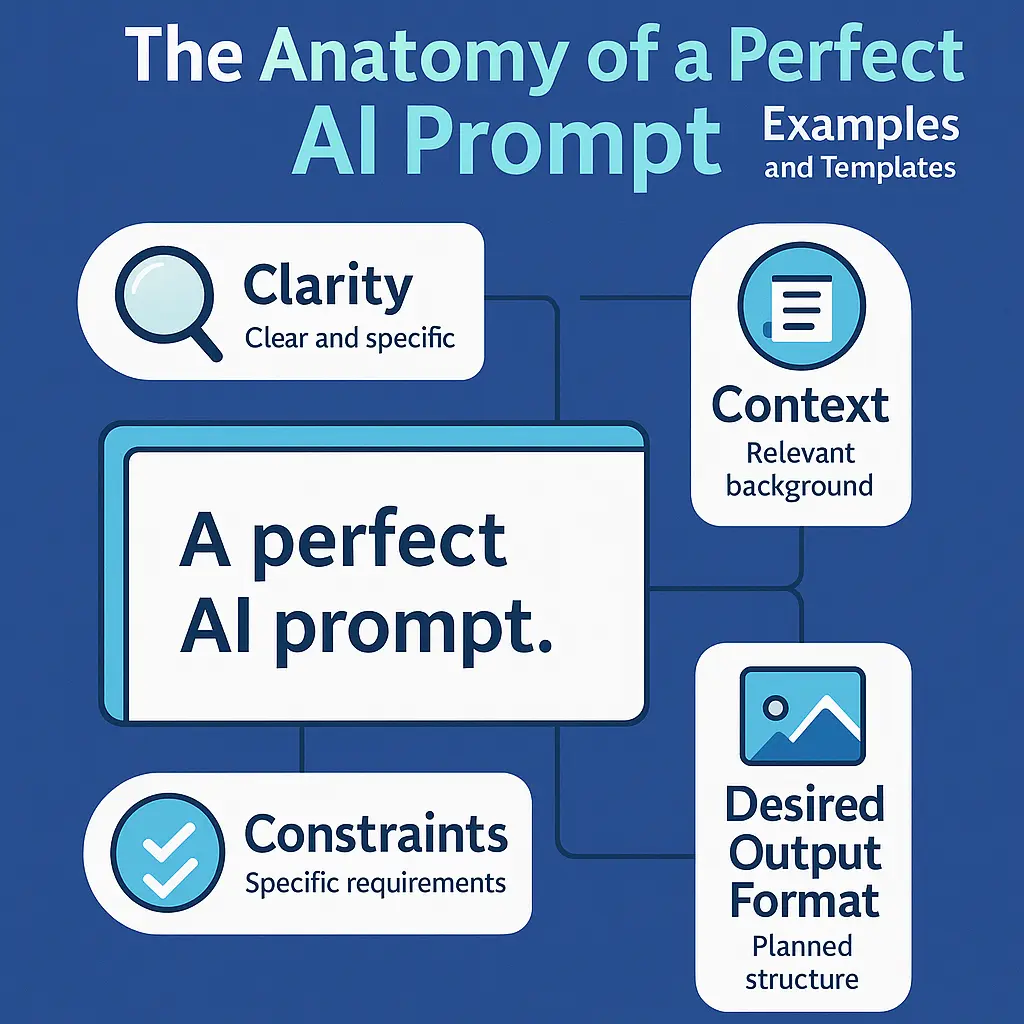
These battle-tested templates provide a starting point for various common use cases. Customize them with your specific requirements. For more templates, explore our anatomy of a perfect AI prompt guide.
Content Writing Template
===ROLE===
You are an expert content writer specializing in [industry/niche].

===TASK===
Write a [content type: blog post/article/guide] about [topic].

===AUDIENCE===
Target audience: [demographic, job role, experience level]
Reader's goal: [what they want to achieve]
Pain points: [what problems they're facing]

===REQUIREMENTS===
- Length: [word count]
- Tone: [professional/casual/authoritative/conversational]
- Include: [specific elements like examples, statistics, actionable tips]
- Avoid: [clichés, jargon, specific phrases]
- SEO keywords: [primary and secondary keywords]

===FORMAT===
Structure the content with:
1. Compelling headline
2. Hook paragraph (2-3 sentences)
3. [Number] main sections with H2 headings
4. Bullet points for scannable lists
5. Conclusion with clear call-to-action

===EXAMPLE STYLE===
[Optional: paste a paragraph showing the writing style you want]
Code Generation Template
===ROLE===
You are a senior [language] developer with expertise in [framework/technology].

===TASK===
Create [function/class/module] that [specific functionality].

===REQUIREMENTS===
Programming language: [language]
Framework/libraries: [specific tools to use or avoid]
Functionality: [detailed description of what the code should do]
Constraints: [performance requirements, compatibility needs]

===INPUT/OUTPUT===
Input: [describe input format and type]
Expected output: [describe expected output]
Edge cases to handle: [list potential edge cases]

===CODE STANDARDS===
- Follow [style guide: PEP 8, Google Style, etc.]
- Include inline comments explaining complex logic
- Add docstrings for all functions
- Implement error handling
- Include type hints (if applicable)

===ADDITIONAL===
After the code, provide:
1. Brief explanation of the approach
2. Time complexity analysis
3. Potential improvements or alternatives
Business Analysis Template
===ROLE===
You are a business analyst with 10+ years of experience in [industry].

===CONTEXT===
Company: [brief company description]
Current situation: [what's happening now]
Challenge: [the problem to solve]
Goals: [desired outcomes]

===TASK===
Analyze [situation/problem] and provide strategic recommendations.

===ANALYSIS FRAMEWORK===
Please structure your analysis using:
1. Situation Assessment (current state)
2. Problem Identification (root causes)
3. Options Analysis (3-5 alternatives with pros/cons)
4. Recommendation (which option and why)
5. Implementation Roadmap (key steps and timeline)
6. Success Metrics (how to measure results)

===CONSTRAINTS===
Budget: [amount]
Timeline: [timeframe]
Resources: [team size, skills available]
Must avoid: [deal-breakers or non-negotiables]

===OUTPUT FORMAT===
Executive summary (3-4 sentences)
Detailed analysis by section
Action items with owners and deadlines
Learning and Education Template
===ROLE===
You are an expert educator specializing in [subject area].

===STUDENT PROFILE===
Current knowledge level: [beginner/intermediate/advanced]
Learning style: [visual/auditory/kinesthetic/reading-writing]
Age/background: [relevant context]
Learning goal: [what they want to achieve]

===TASK===
Teach me [concept/skill] in a way that matches my learning profile.

===TEACHING APPROACH===
- Start with the big picture before details
- Use analogies and real-world examples
- Include practice exercises
- Check understanding with questions
- Build from simple to complex

===FORMAT===
1. Introduction (why this matters)
2. Core Concept Explanation (use analogies)
3. Detailed Breakdown (step-by-step)
4. Real-World Examples (3-5 examples)
5. Common Misconceptions (what people get wrong)
6. Practice Exercise (hands-on application)
7. Summary (key takeaways)

===PACING===
Explain as if I have [X] minutes to learn this
Break down complex terms when first introduced
Optimizing Prompts for Different ChatGPT Use Cases
Different tasks require different prompting strategies. Here's how to optimize for specific scenarios.
For Creative Writing and Storytelling
Key Strategies:
- Provide rich sensory details and atmosphere in your prompt
- Specify character traits, motivations, and conflicts
- Set clear genre expectations and tone
- Use "show don't tell" language in your instructions
- Request specific narrative techniques (foreshadowing, symbolism, etc.)
Example:
Write a 500-word short story opening in the noir detective genre.

Setting: Rain-soaked Chicago, 1947
Protagonist: Jaded private detective who just received a cryptic letter
Tone: Cynical yet poetic, heavy atmosphere
Style: First-person narration with vivid sensory details
Must include: The detective's internal monologue revealing past trauma

Show the character through actions and observations rather than direct description. Use period-appropriate language and references.
For Data Analysis and Insights
Key Strategies:
- Provide complete datasets or clear data descriptions
- Specify analysis goals and business questions
- Request statistical rigor and methodology transparency
- Ask for visualization recommendations
- Demand caveats and limitations
Example:
Analyze this sales data and provide actionable insights:

[Paste your data or describe it clearly]

Business context:
- E-commerce company selling outdoor gear
- Data covers Q1-Q4 2025
- Recently launched new product category in Q3

Analysis questions:
1. Which product categories show strongest growth trends?
2. Are there seasonal patterns in sales?
3. Which customer segments generate highest lifetime value?
4. What factors correlate with high purchase frequency?

Output requirements:
- Statistical significance noted for all findings
- Clear visualizations described in detail
- Actionable recommendations with expected impact
- Identify any data quality issues or limitations
- Suggest follow-up analyses if relevant
For Technical Problem-Solving
Key Strategies:
- Provide complete error messages and context
- Describe what you've already tried
- Specify your technical environment (versions, OS, etc.)
- Request explanations alongside solutions
- Ask for multiple approaches when applicable
Example:
I'm encountering a database performance issue. Help me diagnose and solve it.

Environment:
- PostgreSQL 15.2
- Ubuntu 22.04 LTS
- 16GB RAM, 4-core CPU
- Database size: 50GB

Problem:
Query execution time increased from 200ms to 5000ms over past month
Affects user dashboard loading time

Query: [paste your SQL query]

What I've tried:
- Added index on user_id column (no improvement)
- Increased shared_buffers to 4GB (minimal impact)
- Ran VACUUM ANALYZE (temporary improvement only)

Please:
1. Analyze the query for optimization opportunities
2. Suggest database configuration changes
3. Recommend indexing strategy
4. Explain your reasoning for each suggestion
5. Estimate expected performance improvement
6. Flag any potential risks or trade-offs
Measuring and Improving Your Prompt Quality
Treat prompt engineering as an iterative skill. Here's how to continuously improve your results.
The CRISP Framework for Prompt Evaluation
Evaluate your prompts using these five criteria:
- Clear: Is the objective immediately understandable? Could someone else read your prompt and know what you want?
- Relevant: Does every piece of information contribute to better output? Is anything missing that would help?
- Instructive: Do you provide enough guidance on format, style, and approach?
- Specific: Are vague terms replaced with precise requirements? Are examples provided where helpful?
- Purposeful: Does the prompt align with your actual end goal? Will the output be immediately useful?
A/B Testing Your Prompts
When quality matters, test variations of your prompt:
- Create 2-3 versions with different approaches (more/less context, different examples, varied structure)
- Run each prompt in a fresh conversation to avoid context contamination
- Evaluate results against your success criteria
- Note which elements improved or degraded quality
- Combine the best elements into an optimized version
Building a Personal Prompt Library
Create a repository of your best-performing prompts:
- Save prompts that consistently deliver great results
- Organize by use case or task type
- Include notes on what makes each prompt effective
- Update templates as you discover improvements
- Share successful prompts with your team to standardize quality
Tools like our iPrompt Generator can help you quickly create optimized prompts based on proven templates.
The Future of Prompt Engineering (2026 and Beyond)
As AI models evolve, prompt engineering techniques advance as well. Here are emerging trends shaping the future.
Multimodal Prompting
ChatGPT increasingly supports image inputs alongside text. Effective multimodal prompts combine visual and textual information:
- Upload reference images to show desired style or format
- Provide diagrams or screenshots for technical troubleshooting
- Use images as examples in few-shot learning
- Request specific visual analysis alongside text interpretation
Meta-Prompting and Self-Improvement
Advanced users ask ChatGPT to improve their prompts:
I want to write a prompt that helps me create compelling LinkedIn posts. Here's my current attempt:

[Your initial prompt]

Please analyze this prompt and suggest specific improvements to make it more effective. Consider:
- Missing context or constraints
- Clarity of instructions
- Format specifications
- Whether examples would help
- Any ambiguous language

Then provide a revised version incorporating your suggestions.
Conversational Prompt Design
Rather than front-loading all information, sophisticated users design prompts that invite ChatGPT to ask clarifying questions:
I need help creating a marketing strategy for my business. Before providing recommendations, please ask me 5-7 questions that will help you understand:
- My target audience
- Current marketing channels
- Budget and timeline
- Success metrics
- Competitive landscape

After I answer, provide a tailored strategy based on my specific situation.
Mastering ChatGPT Prompts: Your Next Steps
Writing better ChatGPT prompts is a skill that compounds over time. Every improvement to your prompting technique yields better results across all your AI interactions. The gap between casual users and prompt engineering experts isn't talent—it's understanding and applying these systematic approaches.
Start by implementing the seven essential elements in your next prompt: clear objectives, role assignment, comprehensive context, format instructions, examples, constraints, and verification requests. Practice the advanced techniques like chain-of-thought and delimiter structuring. Build your personal prompt library with templates for recurring tasks. Most importantly, treat every interaction as a learning opportunity. When a prompt doesn't deliver what you need, analyze why and refine your approach. With deliberate practice, you'll develop an intuition for effective prompting that transforms ChatGPT from a helpful tool into an indispensable productivity multiplier. For ongoing inspiration and optimization, explore our guide to structuring prompts for better AI responses and start experimenting with our free prompt generator today.