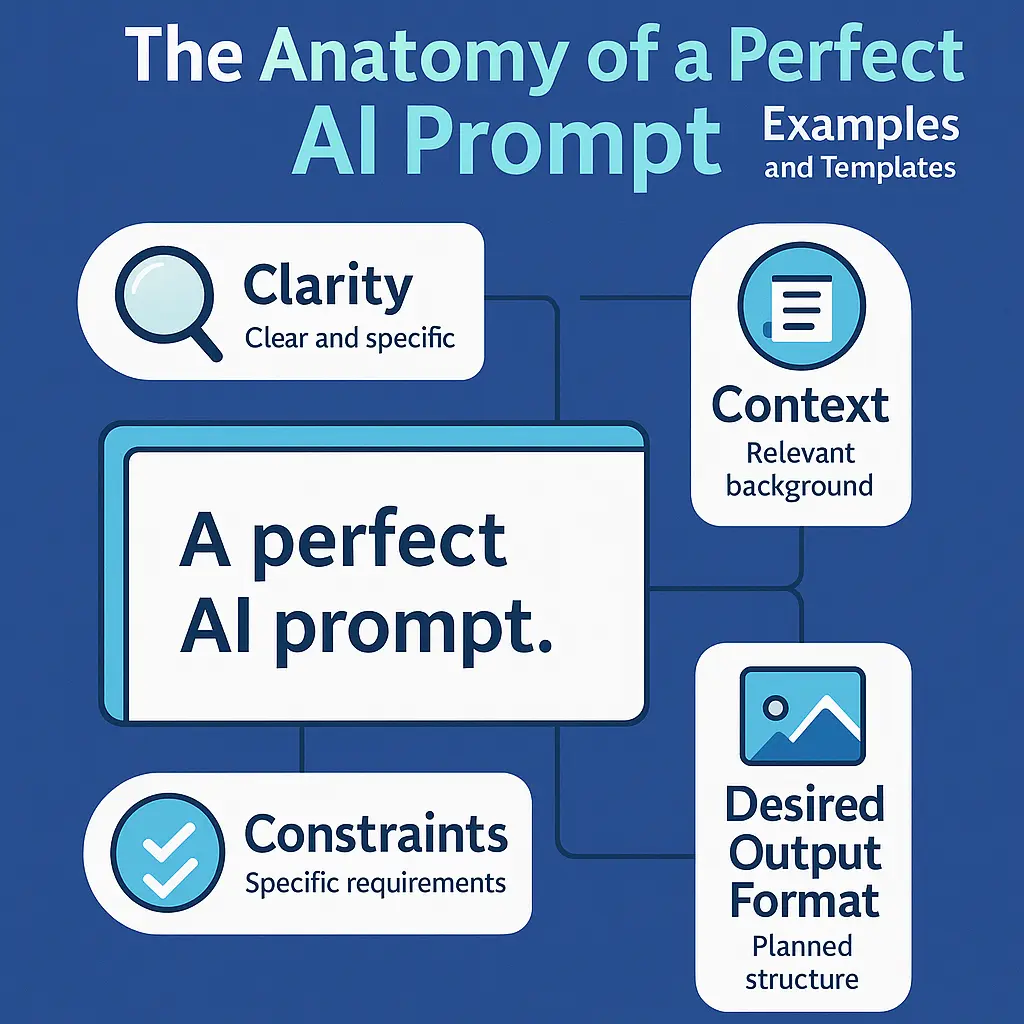
Here's something I learned the hard way: my first attempt at AI prompt writing was asking ChatGPT to "write about AI." The result? A rambling essay that could've been written by anyone, anywhere. I felt like I'd asked a brilliant chef to "make food" without telling them what I was hungry for. That's when I realized that crafting effective AI prompts is less like giving orders and more like having a conversation with someone who genuinely wants to help—but needs you to be specific about what you need.
Think about it this way: you wouldn't walk into a coffee shop and just say "coffee," right? You'd specify whether you want a latte, cappuccino, or espresso, hot or iced, what size, and maybe even your milk preference. AI works the same way. Understanding the essential elements of an effective AI prompt transforms your results from generic to genuinely useful. Whether you're creating marketing copy, getting coding help, or analyzing data, mastering prompt optimization is your secret weapon. Let me walk you through the game-changing elements I've discovered through countless experiments (and yes, plenty of failures). For more context on this skill, check out our guide on introduction to prompt engineering.
1. Clarity: The Foundation of an Effective Prompt
Picture this: you're texting a friend to pick up dinner, and you write "grab something." What do you get? Probably not what you wanted! Maybe they'll bring pizza when you were craving Thai food, or vice versa. This is exactly what happens with unclear AI prompts. Clarity isn't just important—it's absolutely foundational to effective AI prompt writing. When you're crystal clear about what you want, the AI can actually deliver it.
Why Clarity Matters
I once spent an entire afternoon going back and forth with an AI, frustrated that it "just didn't get it." Then I realized—how could it? My prompt was as vague as asking someone to "draw a picture." A picture of what? A sunset? A stick figure? A detailed portrait? AI models are incredibly smart, but they're not mind readers. They rely entirely on what you tell them. When your prompt lacks clarity in prompts, you're essentially asking the AI to guess. And while it'll try its best, those results will be hit-or-miss at best. Clear prompts save you time, reduce frustration, and get you the right answer on the first try instead of the fifth.
Tips for Writing Clear Prompts
- State your goal directly—no dancing around the topic or being overly polite
- Ditch vague verbs like "explain something" or "write anything"—these are prompt killers
- Spell out the topic, the angle you want, and why you need it
- Choose concrete words over abstract concepts (say "red convertible" not "nice car")
- If your request feels complicated, break it into bite-sized pieces
Example
Weak Prompt:
"Write about AI."Effective Prompt:
"Write a 200-word beginner-friendly explanation of how artificial intelligence works, using simple examples."See the difference? The effective prompt gives the AI everything it needs: how long it should be (200 words), who it's for (beginners), what to cover (how AI works), and how to explain it (simple examples). It's like giving someone a detailed recipe instead of just saying "bake something." This level of clarity in your AI prompt writing means you'll get exactly what you need—no guesswork, no do-overs.
2. Specificity: Give the AI a Precise Direction
Remember that time you asked a friend to grab "a drink" for you, and they brought back something you don't even like? Yeah, that's what happens without specificity. Here's what I've learned: specific prompts create specific, high-quality results. It's like the difference between telling a hairstylist "cut it shorter" versus showing them a photo and saying "two inches off the bottom, keep the layers, and add some face-framing pieces." One of these gets you the haircut you want; the other is a gamble. In prompt optimization, specificity is your best friend because it ensures the AI delivers exactly what you're picturing in your head.
What Specificity Includes
- Tone: Should it sound formal or casual? Professional or friendly? Maybe technical?
- Style: Are you telling a story, explaining something, persuading someone, or describing a scene?
- Length: Give a word count, number of paragraphs, or at least a ballpark range
- Target audience: Who's going to read this? Your boss? A teenager? Industry experts?
- Format: Do you want a list, flowing paragraphs, a table, a script, or an outline?
Example
Weak Prompt:
"Create a marketing message."Effective Prompt:
"Write a short, persuasive marketing message (50–70 words) promoting a portable blender to health-conscious college students."Why It Works
This is where the magic happens. The AI now knows exactly who it's talking to (busy college students who care about health), what it's selling (a portable blender—not just any blender), how to sell it (persuasively), and how much space it has to work with (50–70 words—short and punchy). No guessing games, no wasted outputs. When you write specific prompts like this, you're essentially giving the AI a detailed brief, just like you would a freelance writer. And the results? Night and day compared to "create a marketing message."
3. Context: Provide Background Information
Here's a mistake I made early on: I asked AI to "fix this paragraph" without explaining what was wrong with it or what I was trying to achieve. The AI dutifully rewrote it... but made it worse for my purposes. It was like taking your car to a mechanic and saying "fix it" without mentioning the weird noise it's making. Providing context is absolutely essential for effective prompt engineering. Think of context as the backstory that helps AI understand not just what you're asking for, but why you're asking for it. Without this context, you might get something technically perfect but completely useless for your actual needs.
Context Includes
- Background details: What's the situation? What led to this request?
- Purpose of the task: Why do you need this? What will you do with it?
- Your expertise level: Are you a complete beginner, somewhat experienced, or an expert?
- Examples to follow: Show samples of similar content or style you like
- Constraints or limitations: What should the AI definitely avoid or include?
Example
Weak Prompt:
"Fix this paragraph."Effective Prompt:
"Rewrite the following paragraph for a professional tech audience. Improve clarity and remove informal language."Why It Matters
The difference here is huge. In the first version, the AI has no idea what "fix" means—grammar? Tone? Length? Clarity? It's shooting in the dark. But when you add context about your audience (tech professionals who expect a certain level of sophistication) and your goal (clarity without casual language), suddenly the AI knows exactly what adjustments to make. It's the difference between getting a random edit and getting exactly the polished, professional paragraph you needed for that important presentation.
4. Structure: Organize Your Prompt Clearly
Ever received instructions that were just one giant wall of text? Overwhelming, right? Your brain can't process it efficiently. Well, AI feels the same way (okay, not literally, but you get the idea). I used to dump everything into one long sentence, wondering why my results were disorganized. Then I discovered that structure is one of the most essential elements of effective AI prompting. When your prompt is well-organized with clear sections and formatting, the AI can actually parse it better and deliver more organized results. It's like the difference between a messy kitchen counter and one with everything in its proper place—both have the same items, but one makes it so much easier to find what you need.
How to Structure a Prompt
- Break multi-part instructions into bullet points—your AI will thank you
- Separate different steps with line breaks or numbers so nothing gets lost
- Tell the AI upfront what format you want the final output in
- Keep related ideas together in the same section
- Use headings or labels like "Task:", "Audience:", "Tone:" to organize different elements
Example
Weak Prompt:
"Tell me steps to start a business."Effective Prompt:
"Create a 6-step beginner-friendly guide to starting a small business. Format the steps as numbered bullet points and keep each step under 50 words."Why It Helps
See how the second prompt sets clear expectations? It's not leaving anything to chance. You're getting exactly 6 steps (not a rambling essay with 20 steps), each one concise and scannable (under 50 words), formatted as numbered bullets so you can easily follow along, and written for someone just starting out. The AI doesn't have to guess how many steps or how to organize them—you've laid out the blueprint. The result? Clean, organized, actually useful content that looks professional from the first try.
5. Constraints: Set Boundaries for Better Output
This might sound counterintuitive, but limiting the AI actually makes it better. I learned this when I asked for a "short story" and got back 2,000 words when I needed something I could read in two minutes. Constraints aren't about restricting creativity—they're about channeling it in the right direction. Think about how haikus work: the 5-7-5 syllable constraint doesn't kill creativity; it focuses it. The same principle applies to prompt optimization. When you set clear boundaries, the AI doesn't waste energy wandering off-topic or writing a novel when you needed a paragraph. Instead, it delivers polished, focused, usable content.
Types of Constraints
- Word count: Get specific—"exactly 150 words" or "between 200-300 words"
- Tone: Lock in whether you want formal, friendly, technical, casual, or professional
- Format: Spell out if you need a list, table, paragraph, script, outline, or FAQ
- Perspective: First-person storytelling? Third-person reporting? Direct second-person?
- Time period: Historical context? Current events? Future predictions?
- Style restrictions: Tell it what to avoid (jargon, clichés) or emphasize (data, stories)
Example
Weak Prompt:
"Write a short story."Effective Prompt:
"Write a 150-word first-person suspense story with an open ending."Why Constraints Are Essential
With these constraints, you're getting exactly what you asked for: a tight, suspenseful narrative (150 words), told from the main character's perspective (first-person), in a specific genre (suspense), with that delicious ambiguity at the end (open ending). No rambling. No wasted words. Just a focused, engaging story that fits your needs perfectly. It's like ordering a custom-made suit instead of hoping something off the rack will work.
6. Purpose: Tell the AI Why You Need the Output
One of my biggest "aha" moments came when I started telling AI why I needed something, not just what I needed. Imagine explaining blockchain to a kindergartener versus explaining it to a venture capitalist—totally different conversations, right? When you share your purpose, the AI can tailor everything: the vocabulary it uses, how deep it goes into details, even the examples it chooses. It's like the difference between "I need directions" and "I need directions because I'm walking with a stroller and need to avoid stairs." One gets you generic directions; the other gets you exactly what you can actually use.
Example
Weak Prompt:
"Explain blockchain."Effective Prompt:
"Explain blockchain technology in simple terms for a 14-year-old student. The explanation should help them understand the concept for a school project."Why It Matters
Now the AI knows this isn't for a tech conference or a PhD thesis—it's for a teenager working on homework. So instead of drowning the kid in technical jargon about cryptographic hashing, it'll use relatable examples like "imagine a notebook that everyone in class can see, but no one can erase what's already written." Same concept, completely different delivery. That's the power of explaining your purpose.
7. Examples: Show the AI What You Want
You know what revolutionized my AI prompt writing? Actually showing the AI what I wanted instead of just describing it. It's like the difference between telling someone "paint it blue" and showing them a paint swatch. Including examples is honestly one of the easiest ways to instantly boost your output quality. The AI is incredibly good at pattern recognition, so when you give it a concrete reference, it can match that style, tone, structure, and format almost perfectly.
Why Examples Work
Think of it this way: AI models are like talented mimics. Show them what "casual but professional" actually looks like, and they'll nail it. Tell them without showing, and you're rolling the dice on whether their interpretation matches yours. This technique—called "few-shot prompting" in the prompt engineering world—is genuinely one of the most powerful tools in your arsenal. I've seen mediocre outputs become exceptional just by adding a single good example.
Example
Prompt with Example:
"Write a product description in a similar tone to the following example.

Example: 'This sleek, modern water bottle keeps your drink cold for 24 hours and fits perfectly into any active lifestyle.'"
See what happened there? Instead of saying "write it professionally but with personality," you showed exactly what that looks like. The AI now knows the sentence length to aim for, the descriptive words to use ("sleek," "modern"), and how to blend features (24-hour cold) with lifestyle benefits (active lifestyle). It's like giving someone a recipe instead of just naming the dish.
8. Tone: Define How the AI Should Sound
I once got an AI-written email that was so stiff and formal, it sounded like a 19th-century legal document. I was emailing a friend, not a judge! That's when I learned: tone is an absolutely essential element of effective AI prompting. Without telling the AI how to sound, you're basically playing tone roulette—you might get something too stuffy, too casual, or weirdly inconsistent. The right tone makes your content feel like it's actually speaking to your audience, not at them. It's the difference between a robot and a real conversation.
Common Tone Types
- Professional: The suit-and-tie approach—business-appropriate, formal, authoritative
- Friendly: Like chatting with a colleague—warm, approachable, conversational
- Technical: For the experts—precise, detailed, industry-specific vocabulary
- Humorous: The entertainer—light, witty, makes people smile
- Inspirational: The motivational speaker—uplifting, encouraging, energizing
- Empathetic: The good listener—understanding, compassionate, genuinely supportive
Example
Weak Prompt:
"Write a message for customers."Effective Prompt:
"Write a professional yet friendly message informing customers about a temporary service delay."Perfect! Now you're giving the AI a clear tonal direction: professional (we take this seriously and we're competent) yet friendly (we're human and we care about you). This combo is tricky to nail without guidance, but when you specify it, the AI can walk that line beautifully—apologizing sincerely without sounding desperate, being informative without sounding cold. That's the magic of defining your tone upfront.
9. Output Format: Tell the AI Exactly What Format You Need
Here's an annoying thing that used to happen to me constantly: I'd ask for information, and the AI would give me three dense paragraphs when I needed a quick scannable list. Or vice versa—I'd get bullet points when I needed flowing prose. Format matters! It's honestly one of the most important but weirdly overlooked elements in effective AI prompt writing. When you specify the exact format you need, you save yourself the tedious work of reformatting everything afterward. Trust me, your future self will thank you.
Common Formats
- Bullet points or numbered lists—perfect for quick, scannable info
- Tables with specific columns—great for comparisons or organized data
- Step-by-step instructions—when order matters and clarity is key
- Script or dialogue format—for conversations, plays, or video content
- FAQ section—questions and answers that anticipate what people want to know
- Outline format—headings and subheadings for structure and hierarchy
- Comparison table or matrix—when you need to evaluate options side-by-side
Example
Weak Prompt:
"Explain email marketing."Effective Prompt:
"Explain email marketing in a simple list of 5 bullet points, each no longer than 20 words."Now we're talking! Instead of getting a rambling paragraph you'd have to read through carefully, you're getting exactly 5 punchy bullets that you can scan in seconds. Each one is tight (20 words max), giving you just the essentials without the fluff. This is ready to drop into a presentation, email, or blog post without any reformatting. That's the power of specifying your format from the start.
10. Iteration: Refining and Improving the Prompt
Can I let you in on a secret? My best prompts are never my first attempt. They're usually version three or four, after I've seen what works and what doesn't. The absolute best AI users—the ones getting consistently amazing results—treat prompt engineering as an iterative process. Your first prompt is like a rough draft. It gives you something to work with, shows you what's missing, and reveals what you actually need. Then you refine, tweak, and improve. That's where the magic happens.
Why Iteration Works
Think of your first prompt as a conversation starter. It gives you a baseline response, and then you can see what's missing: "Oh, this needs to be shorter," or "Hmm, the tone isn't quite right," or "I forgot to specify the format." Each iteration teaches you something. You're not failing when your first prompt isn't perfect—you're learning. And with each refinement, your results get sharper, more accurate, and more aligned with what you actually needed all along.
Example
First prompt:
"Write about climate change."Refined prompt:
"Write a 300-word scientific explanation of climate change targeted at university students, including two real-world examples."Look at that evolution! The first attempt was basically "tell me stuff about climate change"—super vague. But after seeing a generic, unfocused response, you refined it. Now you've got length (300 words), audience (university students who can handle scientific language), style (scientific but accessible), and concrete requirements (two real-world examples to make it stick). That's the power of iteration—turning "meh" into "exactly what I needed."
Combining Elements for Maximum Effectiveness
Here's where it all comes together. The real power isn't in using just one of these elements—it's in combining them like ingredients in a recipe. A truly effective AI prompt might weave together clarity (so the AI knows what you want), specificity (with exact details), context (why you need it), structure (organized clearly), constraints (focused boundaries), purpose (the end goal), tone (how it should sound), and format (what the final result looks like). When all these elements work together, you're not just writing a prompt—you're creating a detailed blueprint that practically guarantees great results.
Want to level up even more? Check out our guide on how to structure your prompts for better AI responses for advanced techniques on making these elements work together seamlessly.
Conclusion
Look, I'll be honest with you: when I started working with AI, I had no idea what I was doing. My prompts were vague, my results were disappointing, and I wondered if everyone else had some secret manual I didn't get. But here's what I learned: mastering the essential elements of an effective AI prompt isn't some mysterious art—it's a learnable skill that anyone can develop. And once you get it, it's genuinely transformative.
Whether you're writing blog posts, creating marketing copy, debugging code, or brainstorming business ideas, these principles—clarity, specificity, context, structure, constraints, purpose, examples, tone, format, and iteration—will take your AI prompt writing from "sometimes it works" to "wow, this is exactly what I needed." The best part? AI technology keeps getting better, which means your prompts will get even more powerful results as time goes on. So start experimenting with these elements today. Try them one at a time, or layer them all together. Mess up, iterate, and improve. Before you know it, you'll be getting AI outputs that feel less like generic robot responses and more like exactly what you had in mind all along. Ready to see these principles in action? Try our free AI prompt generator—it's built on these exact elements, and you'll see the difference immediately.