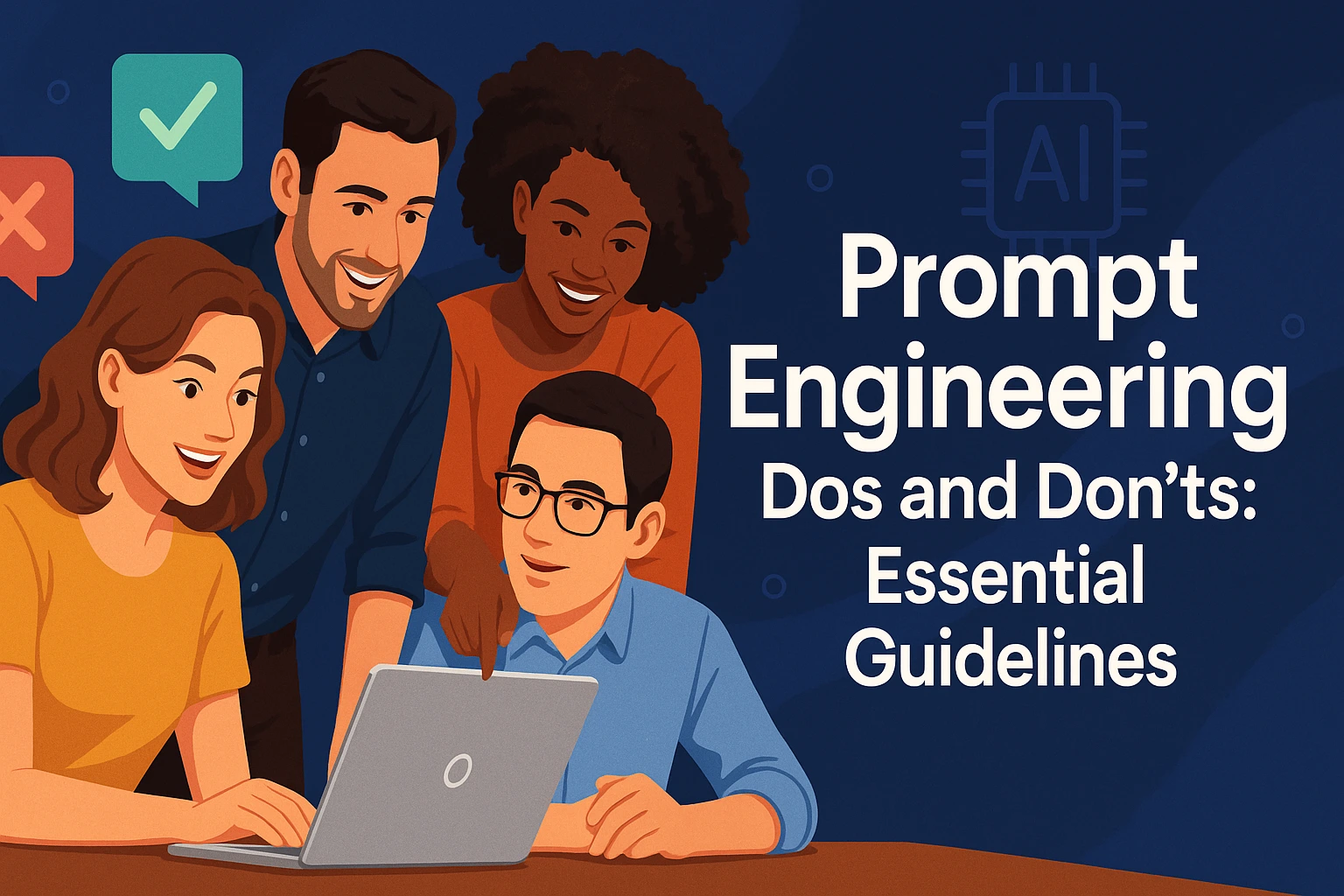
Prompt engineering is both an art and a science. While AI models like ChatGPT and Claude are incredibly powerful, their effectiveness depends entirely on how you communicate with them. A well-crafted prompt can unlock remarkable capabilities, while a poorly constructed one leads to frustration and mediocre results. Understanding the fundamental dos and don'ts of prompt engineering is essential for anyone serious about leveraging AI effectively. This guide distills years of collective experience into actionable guidelines that will help you avoid common pitfalls and adopt practices that consistently deliver superior outcomes. Whether you're a beginner or looking to refine your skills, these principles will transform your AI interactions.
Essential Dos: What Always Works
The foundation of effective prompt engineering lies in following proven best practices. These dos represent techniques that consistently improve AI response quality, reliability, and usefulness across different models and use cases.
DO: Be Specific and Clear
Specificity is the cornerstone of effective prompts. Vague requests produce vague results, while clear, detailed instructions guide the AI toward exactly what you need. Being specific means defining your requirements precisely, including relevant details, and leaving little room for interpretation.
- Instead of: "Write about marketing"
- Do this: "Write a 500-word blog post about email marketing strategies for B2B SaaS companies targeting small businesses, focusing on automation tools and conversion optimization."
The more specific you are, the better the AI can tailor its response to your exact needs. Include details about length, format, audience, tone, and any other relevant parameters. This approach eliminates guesswork and reduces the need for multiple iterations.
DO: Provide Context and Background
Context helps the AI understand not just what you want, but why you want it and under what circumstances. Background information enables the model to make better decisions and produce more relevant outputs.
Good Context Example:

"You are a technical writer creating documentation for a
Python library used by data scientists. The audience consists
of professionals with intermediate Python skills but limited
experience with statistical analysis. The library is designed
for time-series forecasting. Write an introduction that
explains the core concepts without assuming prior knowledge
of time-series analysis."
When you provide context, the AI can adjust its language, depth, and approach accordingly. This leads to outputs that are more appropriate for your specific situation and audience. Context is especially important for complex or specialized tasks where assumptions matter.
DO: Use Examples When Helpful
Examples are one of the most powerful tools in prompt engineering. They show the AI exactly what you want, reducing ambiguity and improving consistency. Few-shot learning through examples is particularly effective for tasks requiring specific formats or styles.
When providing examples, ensure they're clear, representative, and consistent with each other. Two to three examples usually provide enough pattern recognition for the AI to understand your requirements. For more on this technique, see our guide on 10 prompt hacks.
DO: Specify Output Format
Always tell the AI how you want the output structured. Whether you need JSON, markdown, a table, bullet points, or prose, specifying the format upfront saves time and ensures compatibility with your workflow.
- Format specifications: "Format as a JSON object with keys: title, description, tags"
- Structure requirements: "Present as a numbered list with each item containing a heading and 2-3 sentences"
- Style guidelines: "Write in markdown format with H2 headings for main sections"
Format specifications are especially important when you're integrating AI outputs into automated systems or need consistent structure across multiple generations. This practice eliminates post-processing and reduces errors.
DO: Break Complex Tasks Into Steps
Complex requests benefit from step-by-step instructions. Breaking tasks into clear, sequential steps helps the AI process information systematically and produce more thorough, organized results.
When you outline steps explicitly, the AI follows a logical progression that ensures nothing is missed. This approach is particularly valuable for analytical tasks, multi-part projects, or when you need a structured approach to problem-solving.
Critical Don'ts: Common Mistakes to Avoid
Understanding what not to do is just as important as knowing best practices. These don'ts highlight common mistakes that undermine prompt effectiveness and lead to poor results. Avoiding these pitfalls will immediately improve your AI interactions.
DON'T: Be Vague or Ambiguous
Vagueness is the enemy of effective prompts. When you're unclear about what you want, the AI has to guess, and those guesses rarely align with your actual needs. Ambiguous prompts waste time and produce unsatisfactory results.
- Don't: "Make it better" or "Improve this"
- Do: "Rewrite this paragraph to be more concise, use active voice, and include three specific benefits instead of general statements."
If you find yourself being vague, ask yourself: "What specifically do I want?" and "How will I know if the output is good?" Answering these questions will help you craft clearer, more effective prompts.
DON'T: Ask Multiple Unrelated Questions
While AI models can handle complex prompts, asking multiple unrelated questions in a single prompt often leads to incomplete or scattered responses. Each question competes for attention, and the AI may prioritize one over others or provide superficial answers to all.

Instead of combining unrelated questions, create separate prompts for each distinct task. This approach ensures each request receives full attention and produces comprehensive responses. If questions are related, frame them as parts of a single, cohesive task.
DON'T: Assume the AI Knows Your Context
AI models don't remember previous conversations unless you're in an active chat session, and even then, context can be lost or misunderstood. Never assume the AI knows your industry, company, project details, or previous interactions unless you explicitly provide that information.
Always include relevant context in your prompts, even if it seems obvious to you. What's obvious to a human might not be obvious to an AI that processes each prompt independently. Providing context ensures the AI has all the information needed to produce appropriate responses.
DON'T: Use Jargon Without Explanation
While AI models understand a vast amount of terminology, using specialized jargon or acronyms without explanation can lead to misunderstandings. The AI might interpret terms differently than you intend, especially if they have multiple meanings in different contexts.
- Define acronyms: "Using our CRM (Customer Relationship Management) system..."
- Explain technical terms: "Apply the K-means clustering algorithm (an unsupervised machine learning method for grouping data points)..."
- Clarify industry-specific terms: "In SaaS (Software as a Service) terminology, MRR (Monthly Recurring Revenue) refers to..."
When in doubt, provide brief explanations or definitions. This practice ensures the AI understands your terminology exactly as you intend, leading to more accurate and relevant responses.
DON'T: Neglect Output Constraints
Failing to set boundaries often results in outputs that are too long, too short, or include information you don't want. Without constraints, the AI has no guidance on scope, length, or content boundaries.
Always specify constraints relevant to your use case: word count limits, topic boundaries, style requirements, or content exclusions. These constraints help the AI focus and produce outputs that meet your specific needs. For more on maintaining consistency, see our article on consistent AI results.
Advanced Dos: Elevating Your Prompts
Once you've mastered the fundamentals, these advanced techniques will further enhance your prompt engineering skills. These dos represent sophisticated approaches that separate expert prompt engineers from beginners.
DO: Use Role-Playing for Better Context
Assigning specific roles to the AI helps it adopt appropriate expertise, communication style, and depth of knowledge. Role-playing is particularly effective when you need domain-specific insights or professional-level outputs.
Role-Playing Example:

"You are a senior software architect with 15 years of
experience designing scalable web applications. You specialize
in microservices architecture and cloud infrastructure.
Review this system design and provide recommendations for
improving scalability and maintainability."
Role-playing activates specialized knowledge patterns in the AI's training data, leading to more authentic and expert-level responses. This technique is especially valuable for technical, creative, or professional writing tasks.
DO: Iterate and Refine
Perfect prompts rarely emerge on the first try. The best prompt engineers treat their initial prompts as starting points and refine them based on results. Iteration allows you to gradually improve prompts until they consistently produce excellent outputs.
When iterating, identify what worked and what didn't in the initial response. Adjust your prompt to emphasize successful elements and address weaknesses. This iterative approach is how professionals develop highly effective prompts for specific use cases.
DO: Test and Document Successful Prompts
When you find prompts that work well, save them as templates. Building a library of proven prompts creates a valuable resource that ensures consistency and saves time on future projects.
- Document the prompt: Save the exact wording that produced good results
- Record parameters: Note temperature settings, model version, and other relevant settings
- Include examples: Save sample inputs and outputs to demonstrate expected behavior
- Update regularly: Test saved prompts periodically to ensure they still work after model updates
A well-maintained prompt library becomes an organizational asset that improves over time. Consider using tools like our AI prompt generator to create and save standardized prompts.
Advanced Don'ts: Sophisticated Mistakes
These advanced don'ts address more subtle mistakes that even experienced users sometimes make. Avoiding these pitfalls will help you achieve professional-level results.
DON'T: Overcomplicate Simple Tasks
While detailed prompts are generally better, there's a point where additional complexity doesn't improve results and may actually confuse the AI. Simple tasks don't always need elaborate prompts.
If a straightforward request produces good results, don't add unnecessary complexity. Overcomplicating prompts wastes tokens, increases processing time, and can introduce confusion. Learn to recognize when simplicity is more effective than complexity.
DON'T: Ignore Model-Specific Capabilities
Different AI models have different strengths and capabilities. What works well for ChatGPT might not be optimal for Claude, and vice versa. Understanding each model's unique features helps you craft prompts that leverage their specific capabilities.
For example, Claude excels at long-form content and has a larger context window, making it better for tasks requiring extensive background. ChatGPT might be better for creative tasks or when you need more varied outputs. Tailor your prompts to the model you're using. Learn more about model differences in our AI model comparison guide.
DON'T: Forget to Validate Outputs
Even the best prompts can occasionally produce unexpected results. Always validate AI outputs, especially for critical applications. Don't assume that because a prompt worked once, it will always work perfectly.
Implement validation checks for important use cases. Verify that outputs meet your requirements, check for factual accuracy when relevant, and ensure formats are correct. Validation catches issues before they impact your work or users.
Mastering Prompt Engineering: The Path Forward
Effective prompt engineering is a skill that develops through practice and attention to detail. The dos and don'ts outlined in this guide provide a solid foundation, but true mastery comes from applying these principles consistently and learning from each interaction.
Start by focusing on the fundamental dos: be specific, provide context, use examples, and specify formats. Simultaneously, avoid the critical don'ts: don't be vague, don't ask multiple unrelated questions, and don't assume context. As you become more comfortable, incorporate advanced techniques like role-playing and iterative refinement.
Remember that prompt engineering is an iterative process. Even experts refine their prompts based on results. Use these guidelines as a starting point, experiment with different approaches, and develop your own style. The most effective prompts are often those tailored to your specific needs and refined through experience. With practice and these essential dos and don'ts, you'll consistently craft prompts that unlock the full potential of AI models.