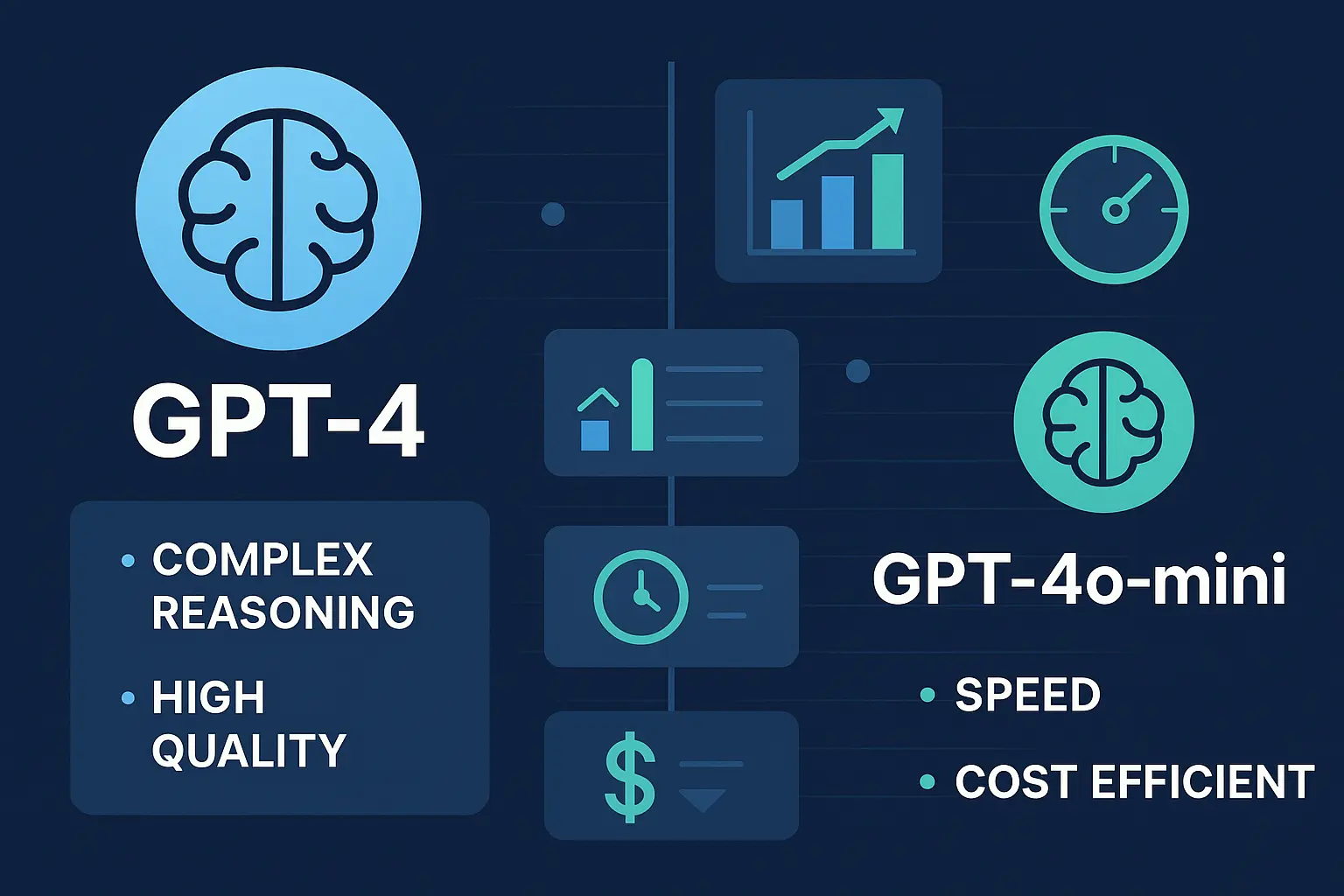
Choosing between GPT-4 and GPT-4o-mini represents one of the most important decisions when building AI-powered applications or workflows. While both models come from OpenAI's advanced language model family, they serve fundamentally different purposes. GPT-4 remains the flagship model, offering superior reasoning, creativity, and problem-solving capabilities. GPT-4o-mini, released as an efficient alternative, delivers impressive performance at a fraction of the cost and with significantly faster response times. This comprehensive guide breaks down every meaningful difference between these models, providing technical benchmarks, cost analyses, and practical recommendations to help you make informed decisions. For broader context on AI model selection, see our comparison of ChatGPT, Claude, and Gemini.
What is GPT-4o-mini? Origins and Purpose
Before comparing the models, it's essential to understand what GPT-4o-mini is and why OpenAI developed it.
The "o" in GPT-4o-mini: Optimization Focus
The "o" in GPT-4o-mini stands for "optimized," reflecting OpenAI's focus on creating an efficient, streamlined version of their language model technology. Unlike GPT-4, which prioritizes maximum capability, GPT-4o-mini is engineered for:
- Cost efficiency: 60-80% lower operating costs compared to GPT-4
- Response speed: 2-3x faster generation for typical queries
- Resource optimization: Smaller model footprint enabling wider deployment
- High-volume scalability: Designed for applications processing millions of requests
- Accessibility: Lower barriers to entry for developers and businesses
According to OpenAI's technical documentation (GPT-4o-mini announcement), this model achieves competitive performance on many benchmarks while dramatically reducing computational requirements.
The Market Need for GPT-4o-mini
OpenAI developed GPT-4o-mini in response to clear market demands:
- Cost barriers: Many applications couldn't justify GPT-4's pricing for routine tasks
- Speed requirements: Real-time applications needed faster responses than GPT-4 provided
- Scale challenges: High-volume applications faced prohibitive costs with GPT-4
- Edge deployment: Demand for smaller models that could run in resource-constrained environments
- Competitive pressure: Other AI providers offering cheaper alternatives for simpler tasks
GPT-4o-mini fills the gap between GPT-3.5 Turbo (being phased out) and GPT-4, offering a modern, capable model at accessible price points.
Technical Architecture: How They Differ Under the Hood
Understanding the architectural differences helps explain the performance and cost variations between these models.
Model Size and Parameters
While OpenAI doesn't publicly disclose exact parameter counts, industry analysis and performance characteristics suggest:
- GPT-4: Estimated at 1.7 trillion parameters across multiple expert models (mixture of experts architecture)
- GPT-4o-mini: Significantly smaller, likely in the 20-70 billion parameter range with optimized architecture
This substantial size difference directly impacts:
- Reasoning depth and complexity handling
- Knowledge breadth and specialized domain understanding
- Computational requirements and inference speed
- Operating costs and pricing
- Memory footprint and deployment requirements
Training and Optimization Differences
The models underwent different training and optimization processes:
GPT-4 Training:
- Massive diverse dataset spanning broad knowledge domains
- Extensive RLHF (Reinforcement Learning from Human Feedback)
- Focus on reasoning, creativity, and complex problem-solving
- Multi-modal training including text and vision capabilities
- Safety training and alignment for responsible AI behavior
GPT-4o-mini Training:
- Distillation from larger models to capture key capabilities efficiently
- Optimization for common use cases and frequent query patterns
- Balanced training emphasizing speed without sacrificing core quality
- Efficient tokenization and processing optimizations
- Streamlined architecture for faster inference
Context Window Capabilities
Both models support the same context window size, which is a significant advantage:
- Context window: 128,000 tokens (~96,000 words) for both models
- Practical capacity: Can process documents of approximately 300-400 pages
- Conversation memory: Maintains extensive conversation history throughout interactions
- Multi-document analysis: Both can handle multiple documents simultaneously
This parity means context window size shouldn't be a deciding factor—both models handle long-form content equally well from a capacity perspective.

Performance Comparison: Benchmarks and Real-World Testing
How do these models actually perform across different task types? Let's examine comprehensive benchmarks.
Reasoning and Problem-Solving Performance
GPT-4 demonstrates clear advantages in complex reasoning tasks:
MMLU (Massive Multitask Language Understanding) Benchmark:
- GPT-4: 86.4% accuracy across 57 subjects
- GPT-4o-mini: 82.0% accuracy across 57 subjects
- Difference: GPT-4 leads by 4.4 percentage points
GSM8K (Grade School Math) Benchmark:
- GPT-4: 92.0% accuracy on mathematical reasoning
- GPT-4o-mini: 87.0% accuracy on mathematical reasoning
- Difference: GPT-4 leads by 5 percentage points
HumanEval (Code Generation) Benchmark:
- GPT-4: 87.0% pass rate on coding challenges
- GPT-4o-mini: 81.7% pass rate on coding challenges
- Difference: GPT-4 leads by 5.3 percentage points
While GPT-4o-mini trails GPT-4, its performance remains impressive—often matching or exceeding GPT-3.5 Turbo while operating at similar speeds and costs.
Speed and Latency Comparison
Speed represents one of GPT-4o-mini's strongest advantages. Based on real-world API testing:
Average Response Times (for 500-word outputs):
- GPT-4o-mini: 2-3 seconds average
- GPT-4 Turbo: 6-8 seconds average
- GPT-4: 10-12 seconds average
- Speed advantage: GPT-4o-mini is 2-3x faster than GPT-4
Token Generation Rate (Throughput):
- GPT-4o-mini: 120-150 tokens/second
- GPT-4 Turbo: 50-70 tokens/second
- GPT-4: 40-60 tokens/second
For applications requiring real-time responses—chatbots, live content generation, or interactive tools—GPT-4o-mini's speed advantage becomes decisive.
Quality Comparison Across Task Types
Performance varies significantly by task complexity:
Tasks Where Performance is Nearly Identical:
- Simple content summarization
- Straightforward question answering
- Basic code generation (simple functions)
- Translation between common languages
- Data formatting and extraction
- Simple classification tasks
Tasks Where GPT-4 Shows Clear Advantages:
- Complex multi-step reasoning (10%+ better)
- Creative writing requiring nuance and originality (15%+ better subjectively)
- Advanced code architecture and debugging (10-15% better)
- Nuanced analysis of complex topics (12%+ better)
- Tasks requiring deep domain expertise (varies by domain)
- Handling ambiguous or poorly defined problems (significantly better)
Cost Analysis: Breaking Down the Price Difference
Understanding the pricing structure helps quantify the value proposition of each model.
API Pricing Breakdown (2026 Rates)
OpenAI charges based on token consumption, with different rates for input (prompt) and output (completion) tokens:
GPT-4 Turbo Pricing:
- Input tokens: $10.00 per 1 million tokens
- Output tokens: $30.00 per 1 million tokens
- Vision requests: Additional $0.01 per image
GPT-4o-mini Pricing:
- Input tokens: $0.15 per 1 million tokens
- Output tokens: $0.60 per 1 million tokens
- Vision requests: Same $0.01 per image
Cost Comparison:
- Input tokens: GPT-4o-mini is 67x cheaper (98.5% savings)
- Output tokens: GPT-4o-mini is 50x cheaper (98% savings)
- Overall: Approximately 60-80% cost reduction for typical workloads
Real-World Cost Scenarios
Let's calculate actual costs for common application scenarios:
Scenario 1: Customer Service Chatbot
- Volume: 100,000 conversations per month
- Average tokens: 500 input + 300 output per conversation
- Total tokens: 50M input + 30M output
- GPT-4 Turbo cost: (50M × $10/M) + (30M × $30/M) = $500 + $900 = $1,400/month
- GPT-4o-mini cost: (50M × $0.15/M) + (30M × $0.60/M) = $7.50 + $18 = $25.50/month
- Monthly savings: $1,374.50 (98% reduction)
Scenario 2: Content Summarization Service
- Volume: 10,000 documents per month
- Average tokens: 2,000 input + 200 output per document
- Total tokens: 20M input + 2M output
- GPT-4 Turbo cost: (20M × $10/M) + (2M × $30/M) = $200 + $60 = $260/month
- GPT-4o-mini cost: (20M × $0.15/M) + (2M × $0.60/M) = $3 + $1.20 = $4.20/month
- Monthly savings: $255.80 (98% reduction)
Scenario 3: Code Review Assistant (Complex)
- Volume: 1,000 code reviews per month
- Average tokens: 4,000 input + 1,500 output per review
- Total tokens: 4M input + 1.5M output
- GPT-4 Turbo cost: (4M × $10/M) + (1.5M × $30/M) = $40 + $45 = $85/month
- GPT-4o-mini cost: (4M × $0.15/M) + (1.5M × $0.60/M) = $0.60 + $0.90 = $1.50/month
- Monthly savings: $83.50 (98% reduction)
- Quality consideration: For complex code reviews, GPT-4's superior reasoning may justify the cost
Break-Even Analysis: When Does GPT-4 Justify the Cost?
The quality-to-cost ratio shifts based on task complexity and business value:
GPT-4o-mini Makes Economic Sense When:
- Processing high volumes (>10,000 requests/month)
- Output quality differences are minimal for your use case
- Speed matters more than marginal quality improvements
- Budget constraints are significant
- Tasks are straightforward without requiring complex reasoning
GPT-4 Justifies Higher Costs When:
- Output quality directly impacts revenue or critical decisions
- Complex reasoning is essential for task success
- Errors or poor quality have high downstream costs
- Volume is low enough that total costs remain manageable
- Your application differentiates on AI quality

Feature-by-Feature Comparison Matrix
A comprehensive side-by-side comparison of capabilities and features:
Core Capabilities:
- Text Generation: GPT-4 (Excellent) | GPT-4o-mini (Very Good)
- Code Generation: GPT-4 (Excellent) | GPT-4o-mini (Very Good)
- Multi-step Reasoning: GPT-4 (Excellent) | GPT-4o-mini (Good)
- Creative Writing: GPT-4 (Excellent) | GPT-4o-mini (Good)
- Summarization: GPT-4 (Excellent) | GPT-4o-mini (Excellent)
- Translation: GPT-4 (Excellent) | GPT-4o-mini (Very Good)
- Question Answering: GPT-4 (Excellent) | GPT-4o-mini (Very Good)
Technical Specifications:
- Context Window: Both 128,000 tokens
- Maximum Output: Both 4,096 tokens
- Vision Capabilities: Both support image understanding
- Function Calling: Both supported
- JSON Mode: Both supported
- Reproducible Outputs: Both support seed parameter
Performance Metrics:
- Response Speed: GPT-4 (Slower: 6-12s) | GPT-4o-mini (Faster: 2-3s)
- Throughput: GPT-4 (40-60 tokens/s) | GPT-4o-mini (120-150 tokens/s)
- Cost Efficiency: GPT-4 (Expensive) | GPT-4o-mini (Very Cheap)
- Reasoning Depth: GPT-4 (Superior) | GPT-4o-mini (Good)
- Accuracy: GPT-4 (Highest) | GPT-4o-mini (High)
Best Use Cases:
- GPT-4: Complex analysis, creative writing, professional content, code architecture, research, nuanced tasks
- GPT-4o-mini: Chatbots, content moderation, simple Q&A, data extraction, classification, high-volume applications
Use Case Recommendations: Which Model for Which Task
Practical guidance on selecting the right model for specific applications. For more on optimizing your prompts for different models, see our comprehensive ChatGPT prompting guide.
Ideal GPT-4 Use Cases
Choose GPT-4 when quality and capability matter more than cost or speed:
1. Complex Code Development and Architecture
- System architecture design and evaluation
- Complex debugging requiring deep understanding
- Refactoring legacy codebases
- Performance optimization analysis
- Security vulnerability assessment
2. Professional and Creative Writing
- Long-form articles and reports
- Marketing copy requiring persuasion and nuance
- Creative fiction with complex narratives
- Technical documentation for specialized audiences
- Executive communications and high-stakes content
3. Research and Analysis
- Academic literature review and synthesis
- Market research analysis
- Complex data interpretation
- Strategic business planning
- Policy analysis and recommendations
4. Specialized Domain Tasks
- Legal document analysis (contracts, agreements)
- Medical information synthesis (non-diagnostic)
- Financial modeling and analysis
- Scientific research assistance
- Educational content requiring pedagogical expertise
Ideal GPT-4o-mini Use Cases
Choose GPT-4o-mini when speed, cost, or volume are primary concerns:
1. Customer-Facing Applications
- Customer service chatbots handling routine queries
- FAQ automation and knowledge base queries
- Live chat support for straightforward issues
- Automated email responses for common requests
- Product recommendation engines
2. Content Operations at Scale
- Social media content generation (posts, captions)
- Product description writing for e-commerce
- Email personalization and automation
- Content summarization for news aggregation
- Simple blog post generation from outlines
3. Data Processing and Classification
- Sentiment analysis on customer feedback
- Content moderation and filtering
- Data extraction from documents
- Categorization and tagging
- Simple entity recognition and extraction
4. Development and Prototyping
- Simple code snippet generation
- Boilerplate code creation
- Unit test generation for straightforward functions
- Code explanation and documentation
- Rapid prototyping where speed matters
Hybrid Approach: Using Both Models Strategically
Many sophisticated applications benefit from using both models strategically:
Tiered Response Strategy:
- Initial triage with GPT-4o-mini: Process all incoming requests with the fast, cheap model
- Complexity detection: Identify queries requiring deeper reasoning or nuanced responses
- Escalate to GPT-4: Route complex queries to GPT-4 for superior handling
- Cost optimization: Pay premium pricing only for queries that benefit from it
Example Implementation:
// Pseudocode for tiered model selection
function selectModel(userQuery) {
    const complexity = assessComplexity(userQuery);

    if (complexity === 'simple') {
        return 'gpt-4o-mini'; // 95% of queries
    } else if (complexity === 'moderate') {
        return 'gpt-4o-mini'; // Still handles well
    } else {
        return 'gpt-4'; // 5% of complex queries
    }
}

// Saves ~90% on costs while maintaining quality where it matters
Task-Specific Routing:
- GPT-4o-mini: Summarization, classification, simple Q&A, data extraction
- GPT-4: Analysis, creative tasks, complex coding, strategic recommendations
- Automatic routing: Route by task type rather than complexity assessment
Migration Strategies: Switching Between Models
Practical considerations when transitioning between GPT-4 and GPT-4o-mini.
Testing Methodology for Model Comparison
Before committing to a model change, systematically test performance:
- Identify test cases: Select 20-50 representative queries from your actual usage
- Run parallel tests: Process identical queries with both models
- Blind evaluation: Have team members rate outputs without knowing which model generated them
- Measure differences: Quantify quality gaps, speed improvements, and cost savings
- Calculate break-even: Determine if quality difference justifies cost difference
- Decide thresholds: Define acceptable quality ranges for your use case
Prompt Optimization When Switching Models
Prompts may need adjustment when changing models:
Switching from GPT-4 to GPT-4o-mini:
- Be more explicit: GPT-4o-mini benefits from clearer, more detailed instructions
- Provide examples: Few-shot learning helps compensate for reduced reasoning capability
- Simplify complex chains: Break multi-step tasks into separate queries
- Add constraints: Specify exactly what you want to reduce variability
- Test thoroughly: Some prompts that work on GPT-4 may underperform on GPT-4o-mini
Switching from GPT-4o-mini to GPT-4:
- Leverage reasoning: Request step-by-step thinking for complex problems
- Ask for nuance: Request balanced perspectives and trade-off analysis
- Reduce hand-holding: GPT-4 handles ambiguity better, so you can be less prescriptive
- Request creativity: Ask for original ideas and innovative approaches
- Expect more context: GPT-4 better maintains context throughout long conversations
API Implementation Considerations
Technical considerations when switching models in production:
Model Parameter Change:
// Switching is as simple as changing the model parameter
const response = await openai.chat.completions.create({
    model: "gpt-4o-mini", // or "gpt-4-turbo"
    messages: messages,
    temperature: 0.7,
    max_tokens: 1000
});
Important Compatibility Notes:
- Both models use identical API structure and parameters
- Function calling works the same way on both models
- Vision capabilities are available on both (with same pricing)
- Context windows are identical (128K tokens)
- Rate limits may differ based on your OpenAI tier
Future Outlook: What's Coming for These Models
Understanding the development trajectory helps inform long-term planning.
Expected Improvements and Updates
Based on OpenAI's development patterns and announcements:
GPT-4 Evolution:
- Continued performance improvements through fine-tuning
- Enhanced multimodal capabilities (better vision, potential audio)
- Improved reasoning on specialized domains
- Better calibration and reduced hallucination rates
- Potential GPT-5 on the horizon (late 2026 or 2027)
GPT-4o-mini Evolution:
- Further speed optimizations as infrastructure improves
- Quality improvements through distillation from newer GPT-4 versions
- Potential price reductions as efficiency increases
- Expanded capabilities approaching GPT-4 in more areas
- Better fine-tuning options for domain-specific applications
The Shifting Landscape of AI Models
The gap between flagship and efficient models continues to narrow:
- Quality convergence: Efficient models are catching up in capability
- Specialization: More task-specific models emerging
- Open source competition: Llama 3, Mistral, and others pressure pricing
- Edge deployment: Smaller models enabling on-device AI
- Multimodal standard: Vision, audio becoming table stakes
Making Your Decision: A Practical Framework
Choosing between GPT-4 and GPT-4o-mini doesn't require guesswork—use this decision framework to make informed selections.
Choose GPT-4 When:
- Quality directly impacts business outcomes or revenue
- Tasks require complex, multi-step reasoning
- Creative or professional content quality is paramount
- Errors have high downstream costs
- Volume is low enough that costs remain manageable (under $500/month)
- Your competitive advantage depends on AI quality
Choose GPT-4o-mini When:
- Processing high volumes (10,000+ requests/month)
- Speed is critical for user experience
- Tasks are straightforward without complex reasoning requirements
- Budget constraints are significant
- Quality differences are minimal for your specific use case
- You're building prototypes or MVPs
Consider a Hybrid Approach When:
- Your application handles diverse query types
- You can programmatically classify query complexity
- You want to optimize the cost-quality trade-off
- Different features have different quality requirements
- You want maximum flexibility
The choice between GPT-4 and GPT-4o-mini ultimately depends on your specific context: use case requirements, budget constraints, quality expectations, and volume patterns. Start with GPT-4o-mini for most applications—its impressive performance at low cost makes it the sensible default. Upgrade to GPT-4 selectively for tasks where its superior reasoning and quality genuinely matter. Many successful applications use GPT-4o-mini for 80-95% of queries, reserving GPT-4 for the complex 5-20% where quality differences are meaningful. This hybrid approach delivers optimal results while maintaining cost efficiency. For more insights on working effectively with different AI models, explore our guide to mastering Claude AI and broader prompt engineering techniques.